

UCAT Tips: Decision Making
From pesky syllogisms to wacky logic puzzles, this section tests the greatest variety of cognitive skills.

While Decision Making (DM) does not have as much reading to do as Verbal Reasoning, there are many more question types to wrap your head around. It's the intersection of words and numbers, requiring strong literacy and numeracy skills to carefully interpret the questions — there are many strategies question writers can use in DM to catch you out!
OVERVIEW
29 questions involving texts, charts, tables, graphs and Venn diagrams.
31 minutes, or 60 seconds per question.
Syllogisms questions generally appear at the start of the section, while Probability questions appear towards the end. Logic Puzzles, Evaluating Arguments, and Venn Diagrams questions are usually found in the middle.
DM DEFINITIONS 📖
Before we delve into the question types, it is important to be aware of the definitions of specific language used in DM. Knowing these definitions by heart is crucial in understanding the meaning of a question, e.g. what is the difference between 'many people' and 'most people'?
ALL: An unspecified number referring to the whole of it/everything.
ALWAYS: On all occasions, without fail.
EITHER: Exclusively A or B (not both).
FEW: A small number of, less than 50%.
MAJORITY: A number that is more than 50% of the whole but not all.
MANY: An undetermined number similar to 'some'. A part of it, not all of it.
MOST: An undetermined but majority number/largest part.
NONE: Not even a small amount/not even one.
NOTHING: Not a single thing. Of no value.
NOT ALL: 1-99%.
ONLY: Introduces something which must happen before something else in the sentence. Indicates there is nothing else.
SOME: An undetermined number being more than one but less than all. A part of it, not all of it.
UNLESS: Introduces the only circumstance which makes the statement not true or valid.
SYLLOGISMS ↪️
This question type usually forms nine of the 29 questions.
Partial marking is possible for these questions. If you match all five statements correctly, you will get two marks. If you match four statements correctly, you will get one mark. Matching fewer than four statements correctly will give zero marks.
All the information in the question stem is taken to be True.
The key point here is to focus on the links between people and objects, which are usually signposted with identifying words.
Statements can fall into a number of types:
copy and paste
not enough information (always No)
inferences
hypotheticals
Extra information is often a sign that the statement should be matched to No. Typical examples of putting extra information into the statement are generalisations, exaggerations, or adding specific objects that are not mentioned in the question stem.
Consider each statement separately — there is no pattern of Yes and No in the five statements, as they are meant to be standalone.
In comparison to the True/False/Can't Tell questions in Verbal Reasoning:
True statements will correspond to Yes.
False and Can't Tell statements will both correspond to No.
Syllogisms example 1
Not all the people present at the literature festival were poets. All the poets at the literature festival were authors and some poets were not storytellers.
Place 'Yes' if the conclusion does follow. Place 'No' if the conclusion does not follow.
At least one storyteller at the literature festival was an author.
At least one author at the literature festival was both a poet and a storyteller.
All the authors at the literature festival were either poets or storytellers.
Not all authors at the literature festival who were poets were storytellers.
All the storytellers at the literature festival who were poets were authors.
Answers:
1st conclusion – Does follow because since some poets were not storytellers, then at least one storyteller was a poet, and since all poets were authors, this also means that at least one storyteller was an author.
2nd conclusion – Does follow because since all poets were authors and at least one poet was also a storyteller (because some were not), it can be concluded that at least one author was both a poet and a storyteller.
3rd conclusion – Does not follow because we cannot conclude from the given statement that all authors were either poets or storytellers.
4th conclusion – Does follow because some poets were not storytellers; therefore not all authors who were poets were storytellers.
5th conclusion – Does follow because all poets were authors, so all the storytellers who were poets were authors.
Syllogisms example 2
There are males and females in my family. Some of the females like golf but the other members of my family are having a meal.
Place 'Yes' if the conclusion does follow. Place 'No' if the conclusion does not follow.
None of the females are having a meal.
If a family member likes golf, they must be female.
Some of my family having a meal like golf.
If a female is having a meal, they must not like golf.
If a family member is at the meal, they must be female or not like golf.
Answers:
1st conclusion – Does not follow because only some females like golf. "The others" who are having a meal must therefore include some females.
2nd conclusion – Does not follow because we can't tell from the given information – there may be males who also like golf.
3rd conclusion – Does not follow because we can't tell from the given information – there may be males who also like golf, but there also may be no males who like golf.
4th conclusion – Does follow because lines 2 and 3 explain that any female who does not like golf is having a meal.
5th conclusion – Does not follow because we don't know if any males in the family like golf.
LOGIC PUZZLES 🧩
This question type usually forms five of the 29 questions.
A common trap many people fall into is trying to solve the entire logic puzzle, i.e. deduce all of the details from the given information. However, the questions often do not require you to solve the whole puzzle to choose the correct answer. So, once you have figured out enough to answer the question, choose your answer and move on instead of completing the puzzle, as the latter will waste precious time!
Skim through the puzzle and the rules quickly to familiarise yourself, then check the question. Return to the rules and start matching rules to narrow down the options.
As you are going through the rules, use your physical whiteboard to keep track of the matches you have made. If it is relevant, putting things in their correct order on your whiteboard can help visualise things and avoid making mistakes. As you make a match, check the answer options to see if you can eliminate an option.
A possibility is not certainty — rules will often help you narrow down a position to two or three items, but this is insufficient evidence. Some rules will purposely mislead you down this path. Keep in mind what information you do and do not know.
Focus on rules that narrow things down — target rules that will give you the most information for the time spent. Avoid rules which open up more possibilities until you need to use them.
Logic puzzle example 1
I walk my dogs daily.
Barker and Dainty have to walk alone.
Boxer goes for an afternoon walk.
Dainty is the only dog who has two walks each day.
Rex always has his morning walk with another dog.
Which one of the following MUST be true?
A. Boxer is Rex's companion.
B. Boxer has more than two walks a day.
C. I have at least five dogs.
D. Each day I have to make a minimum of six walks with my dogs.
Answer: C. From the information given, we can deduce that Rex has his morning walk with another dog, but this cannot be Barker or Dainty as they have to walk alone, and it cannot be Boxer as he goes for an afternoon walk. So there must be one other dog that is Rex's companion on his morning walk.
Logic puzzle example 2
Four people H, I, J, K are a doctor, a manager, a teacher and a lecturer, not necessarily in that order. They each own a different type of vehicle.
H is a doctor.
J owns a sports car.
K owns an electric car.
The person who owns a motor bike is not the teacher.
The manager polishes her scooter every weekend.
Which one of the following MUST be true?
A. K is a teacher.
B. J is a teacher.
C. I is a manager.
D. K is a manager.
Answer: C. From the information given, we can deduce that I is the manager and owns a scooter as we know that H is a doctor and J and K own cars that are not owned by the manager.
Response A is incorrect because K could be the teacher but they could equally be the lecturer.
Response B is incorrect because J could be the teacher but they could equally be the lecturer.
Response D is incorrect because K owns an electric car and the manager has a scooter.
As we are looking for the response that MUST be true, we have to choose the response option that we are certain about.
EVALUATING ARGUMENTS 🗣️
This question type usually forms four of the 29 questions.
These questions always have the following wording:
Should X happen in order for Y to happen? [where X is a particular action proposed and Y is the desired outcome for that action]
Select the strongest argument from the statements below.
The strongest argument will use the specific wording of the question and will not require assumptions to make logical sense, while the weakest arguments use generalisations, exaggerations, stereotypes or bias.
Look out for opinionated arguments, which often use soft qualifiers (see VR post) and lack factual evidence. These will not be the strongest argument.
Two common assumptions to look out for:
More available ≠ more being done. Just because you make more of something available, it does not mean that it will be used in the way you expect, or even at all.
An average is not an individual prediction. Just because you are a part of a group, it does not mean you are the average/have all the characteristics of that group.
The strongest No arguments typically offer an alternative solution. This is because it is not necessarily enough to offer a justification — the argument must actually address the problem that is presented or offer another option that will reach the desired outcome (Y).
Evaluating arguments example
Would society be safer if urban areas had designated dog-walking areas where pets could be exercised without causing danger to people?
Select the strongest argument from the statements below.
A. Yes, it is better for dogs that live in towns to be exercised in separate areas where they cannot frighten people and leave waste that can be harmful to children.
B. Yes, it is important that dogs are properly exercised and ideally they should be allowed to be free to run off the lead without restriction.
C. No, it is the responsibility of dog-owners and not local councils to find somewhere to exercise dogs safely away from people and dangerous traffic.
D. No, towns and built-up areas are already overcrowded and any undeveloped land should be used to provide new houses rather than playgrounds for pets.
Answer: A. A is correct because it addresses the question of safety and also the particular concern of danger to children as a specific group of "people".
B is incorrect because it focuses on the needs of dogs and not the danger to people.
C is incorrect because it focuses on who should provide the designated areas rather than the danger to people.
D is incorrect because it doesn't acknowledge that the reasoning behind providing the designated areas is to reduce the danger to people.
VENN DIAGRAMS ➰
This question type usually forms four of the 29 questions.
These questions may ask you to interpret a given Venn diagram or choose the Venn diagram that best represents given data.
Use your physical whiteboard. If you need to remember something, note it down on your whiteboard to avoid confusing yourself and doing too many things.
If a question asks you to find the overlap between three items, it can be faster to just locate one of those items and just look for where it overlaps with two other items instead of finding all three items separately and seeing where they overlap.
Venn diagrams example
A company conducted a survey at two of its business centres – Centre A and Centre B – to find out which centre had more employees who were active on social media.
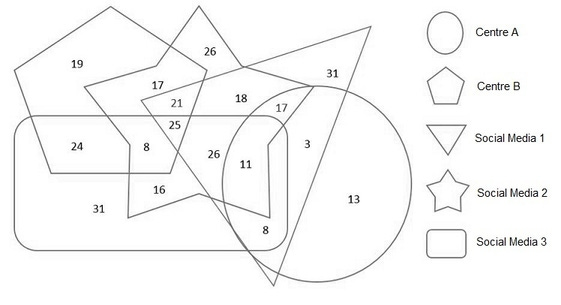
Based on the diagram, which of the following statements is true?
A. Centre A has five fewer employees on only Social Media 3 than Centre B.
B. Centre B has more employees active on Social Media 3 than Centre A.
C. Both centres have exactly the same number of employees active on social media.
D. Centre B has fewer employees not on social media than Centre A.
Answer: B. B is correct because:
Centre A employees active on Social Media 3 = 11 + 8 = 19.
Centre B employees active on Social Media 3 = 24 + 8 + 25 = 57
So Centre B has more employees than Centre A on Social Media 3.
A is incorrect because 0 Centre A employees are active only on Social Media 3, and 24 Centre B employees are only on Social Media 3. 24 - 0 = 24 fewer employees.
C is incorrect because:
Centre A employees on social media = 17 + 3 + 8 + 11 = 39
Centre B employees on social media = 17 + 21 + 25 + 8 + 24 = 95
So both centres do not have exactly the same number of employees on social media.
D is incorrect because Centre A has 13 employees not on social media and Centre B has 19, so Centre B has more employees not on social media.
PROBABILITY 🎲
This question type usually forms four of the 29 questions.
Decision-based questions provide you with two options, A or B, and two things about these options that you can use to decide which option is preferable.
Once you have decided on the side you are picking on, Yes or No, look at the options for that side and decide on which one best fits your approach and is actually relevant to the question. Keep in mind that just because something is true does not mean it is relevant.
Look out to see if objects are returned to the pot/container or not. The order of objects is also important.
Probability example 1
X and Y play a game by taking turns to throw a biased six-sided dice.
On a biased dice, some numbers are more likely to be rolled than others.
The first person to throw a six wins.
X throws first.
X and Y have an equal chance of winning no matter how biased the dice.
A. Yes, they are using the same dice so have the same probability of throwing a six when it is their turn.
B. Yes, the fact that the dice is biased does not affect the probability of individual throws.
C. No, X has a better chance of winning as he has to fail on his turn in order for Y to have a chance of winning.
D. No, X has a better chance of winning when the dice is biased towards a six.
Answer: C. C is correct because in the sequence X then Y on any pair of turns, before Y can succeed X must fail, so the probability of X failing then Y succeeding is less than X succeeding.
A and B are incorrect because the important thing to consider is that X throws first, as X has a chance of winning before Y even has a turn.
D is incorrect because the way in which the dice is biased does not change the chance of winning for X – what is relevant is that X throws first.
Probability example 2
A football coach plans to replace a player of his team in the second half of a match. If Player A is replaced, there will be 80% chance of the coach's team scoring a goal and 70% chance of the opponent team scoring a goal. If Player B is replaced, there will be 20% chance of the coach's team not scoring a goal and 50% chance of the opponent team not scoring a goal.
Considering only the likelihood of the coach's team scoring a goal and the opponent team not scoring a goal, is Player A the better replacement choice?
A. Yes, there is a 20% higher chance of the opponent team not scoring if Player A is replaced.
B. Yes, there is a 60% higher chance of the coach's team scoring if Player A is replaced.
C. No, there is a 20% higher chance of the opponent team not scoring if Player B is replaced.
D. No, there is a lower chance of the coach's team scoring if Player A is replaced.
Answer: C. C is correct because as shown for A, there is a 30% chance of the opponent team not scoring if Player A is replaced and a 50% chance of the opponent team not scoring if Player B is replaced. This means there is a 50 – 30 = 20% higher chance of the opponent team not scoring if Player B is replaced.
A is incorrect because there is a 100 – 70 = 30% chance of the opponent team not scoring if Player A is replaced and a 50% chance of the opponent team not scoring if Player B is replaced. This means there is a 50 – 30 = 20% lower chance of the opponent team not scoring if Player A is replaced.
B is incorrect because there is an equal chance of the coach's team scoring when either player is replaced (an 80% chance of scoring is the same as a 20% chance of not scoring).
D is incorrect because as shown in B, there is an equal chance of the coach's team scoring when either player is replaced.
OVERALL
Decision Making is one of the more fun sections of the UCAT once you have wrapped your head around the structures of each question type, in my opinion. Although it was my lowest scoring section in my second attempt of the UCAT, I was able to finish with some time to spare.
I knew that I spent the most time on Syllogisms questions, and since they always come first in Decision Making, I developed a strategy of skipping all of them immediately once the timer began and leave them until last. By doing them last, it meant that I did not have as much time left compared to doing them at the start to dwell on all the statements and waste time overthinking the meanings of the words used (see DM definitions at the top of the post). Doing Syllogisms questions at the end also gave me more precious time for more tricky Venn diagrams questions where you have to look at multiple parts of the diagram to eliminate answer options.
You will find in your DM preparation which question types are the easiest and hardest for you. Use this information to your advantage by spending more time on your weakest question type and doing your strongest question types first in the real exam.
Brain teasers, such as sudoku and crossword puzzles, can be a relaxing yet very effective way to develop the cognitive thinking required to quickly understand and disseminate DM questions, so this might be something worth considering!